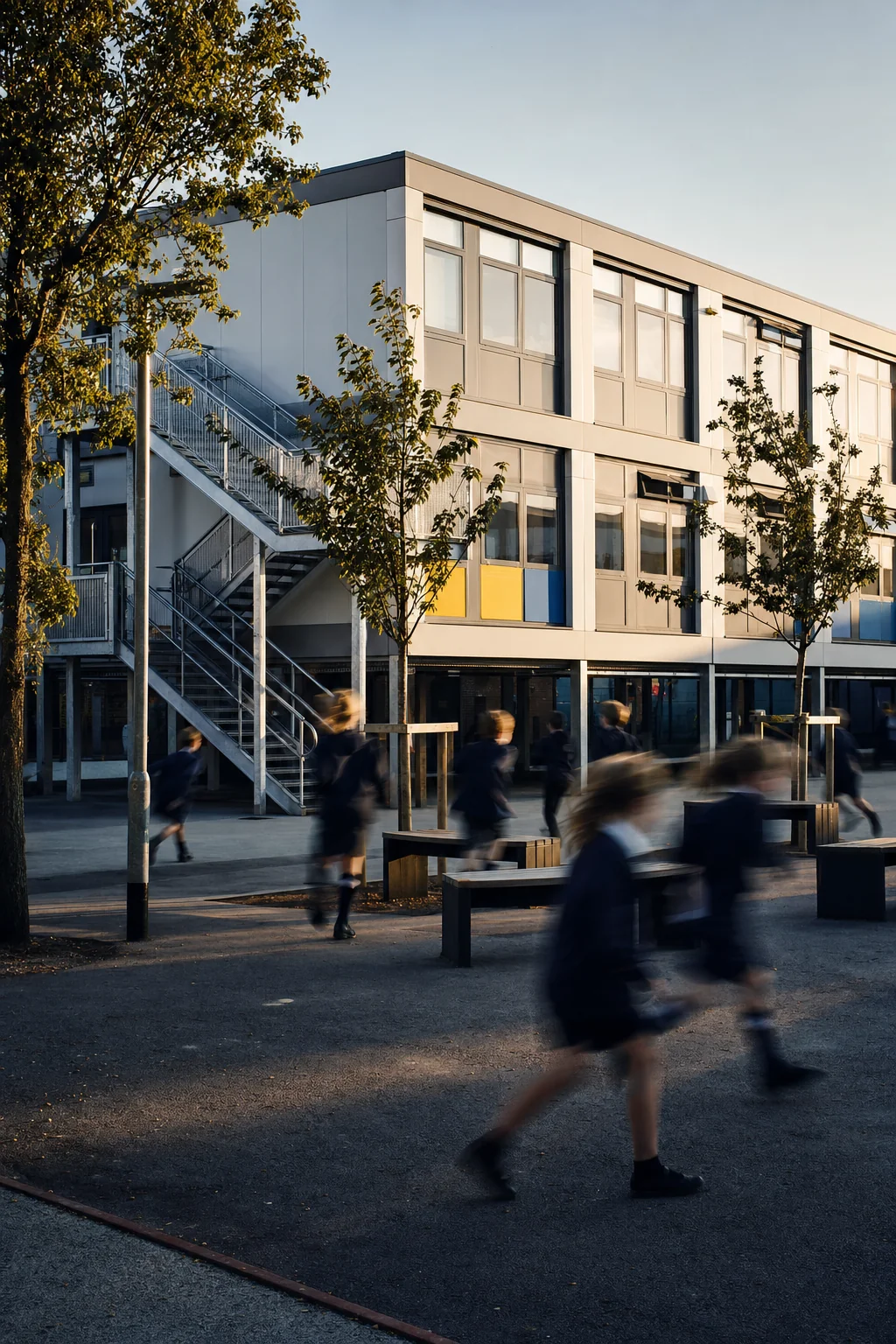
The question is fair. A municipality refurbishing a school or expecting rising pupil numbers needs figures for the budget. And it needs them early, because budgets have to be approved and dates have to be met. Even so, you will not find a blanket price in this article. Not because we do not want to do the sums, but because a figure given without knowledge of the project is not information, it is an assertion.
Two temporary school buildings can look almost identical from outside and differ in price by a multiple. One stands for two years on a serviced playground, rented, with a simple fit-out. The other is bought, serves for ten years as an interim solution and has a sanitary wing, mechanical ventilation and full IT cabling. Same keyword, completely different project.
What we give you instead: the real cost drivers, explained one by one. Anyone who knows them can read quotations, compare them properly and draw up a budget that holds in the end.
Why reputable suppliers do not quote a blanket price
A blanket price without knowledge of the project comes about in one of two ways. Either the supplier builds in a large safety margin, and then you pay too much. Or he prices it tight to win the job, and the difference comes back later as a variation. Neither is our way. Our principle is: honestly costed, not talked up. A reliable figure only exists once the most important questions have been settled. Those are exactly the questions we now look at.
The real cost drivers
Number of classrooms and modules
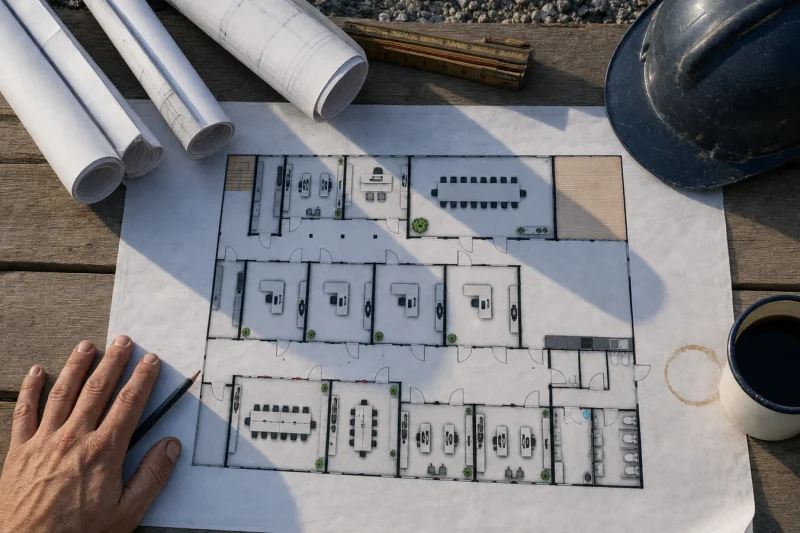
The most obvious factor. More classrooms mean more modules, more transports, more installation time. The relationship is not strictly linear, though. Corridors, stairs in two-storey buildings and plant areas come on top. And ancillary rooms are often forgotten: group rooms, staff room, store room, WCs. Anyone who counts only the classrooms budgets too low.
Fit-out standard: plumbing, ventilation, IT
This is where the biggest differences arise between two buildings that look the same from outside. Plumbing weighs heaviest: WCs need water and waste pipes right up to the module, and that affects the site as well. Mechanical ventilation is often required in classrooms and costs more than window ventilation alone, but it pays off in air quality. Then there is IT: cabling, Wi-Fi, connections for digital whiteboards. For the fit-out we work with standardised packages for electrical, plumbing and air conditioning/ventilation. That makes the costs plannable. It does not make them flat-rate.
Rent or buy: the period of use decides
The tipping factor in the whole budget. For a short period of use, during a refurbishment for example, renting is usually the more economical choice. The longer the building stands, the more buying pays off. Exactly where the tipping point lies depends on the fit-out standard and the residual value, so there is no universal rule here either. A purchased temporary building has a second advantage as well: it can be converted, extended or reused elsewhere later on. Work out both options. We put both on the table.
Foundations and site services
Modules need firm, level ground. Depending on the terrain and the size of the building, pad foundations are enough, or more is needed. Then come the site services: electricity, water, drainage and data have to be brought to the building. If the nearest connection is far away, the service trench becomes a budget item in its own right. This item is rarely in the brochure, but it is always in the final account.
Transport and crane installation
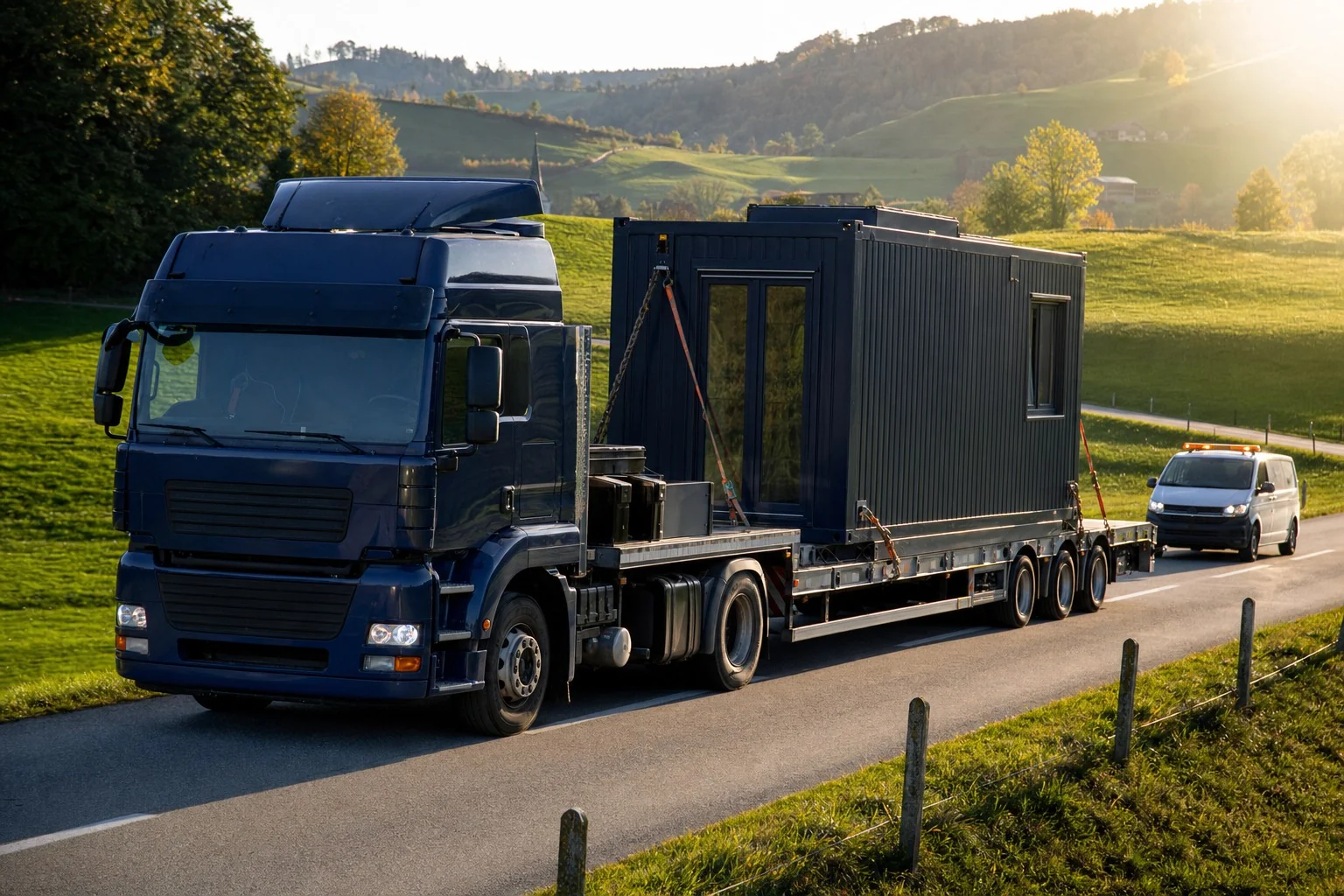
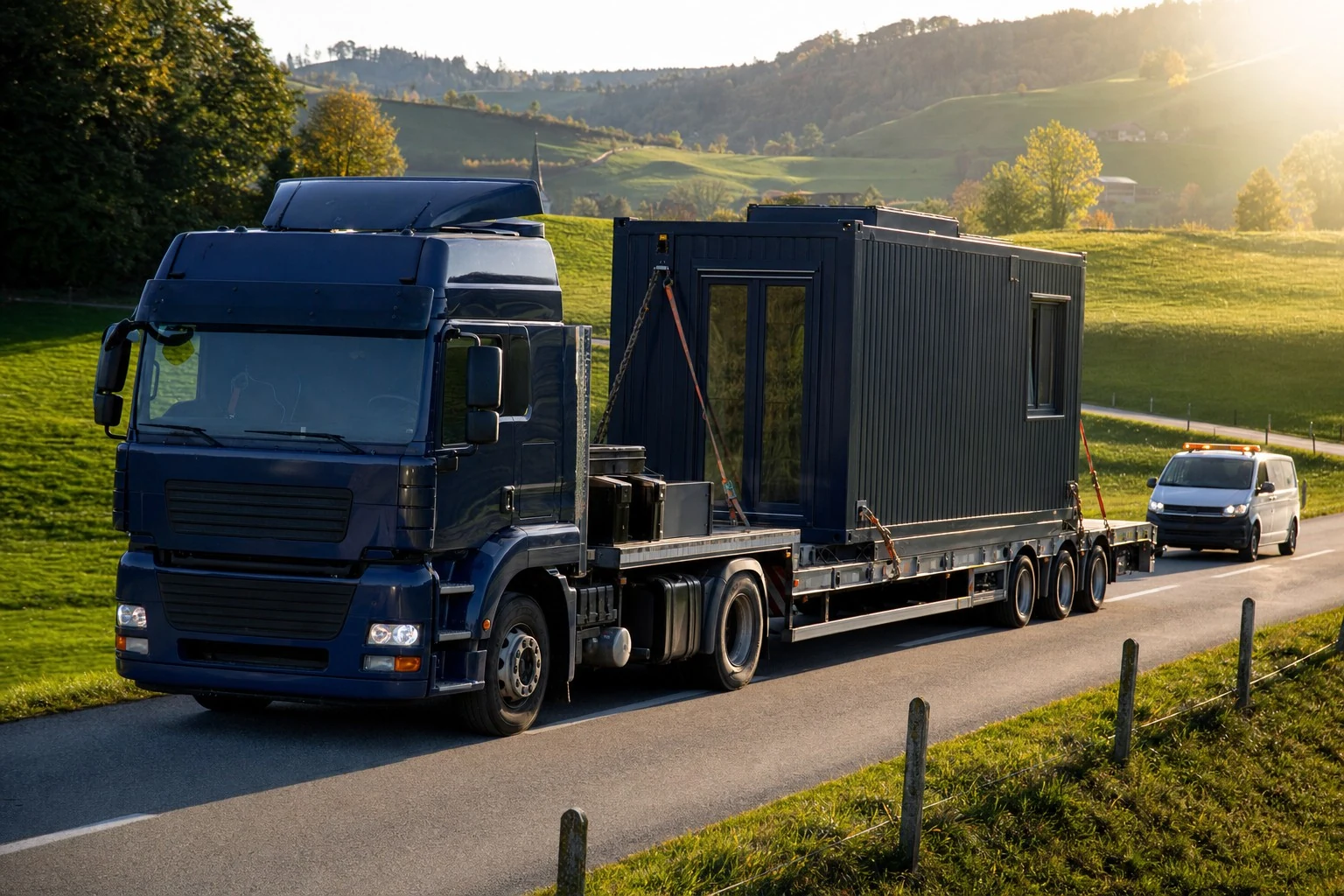
Modules arrive by lorry and are set in place by crane. Distance, access and the space available are what matter. An open meadow next to the sports hall is the easy case. A narrow courtyard with the crane lifting over the school roof is the other. Temporary road closures or abnormal loads also make themselves felt.
Permit and conditions
A temporary building needs a building permit too. With it come conditions: fire protection, escape routes, step-free access, and further evidence depending on the canton. Such conditions cost money, but above all time. Know them early and you can plan for them instead of retrofitting later.
Removal at the end
With time-limited solutions, removal belongs in the budget from the start: dismantling, transport away, reinstatement of the site. If you cannot find removal in a quotation, ask about it. This item does not disappear. It only turns up later.
How a municipality should budget
Our suggestion for a three-step approach:
- Define the requirement. How many classes, which ancillary rooms, which fit-out standard, for how long, from when? The clearer the requirement, the more comparable the quotations.
- Obtain a budget quotation. A reputable budget quotation rests on a conversation and a look at the site, not on a catalogue price per square metre.
- Check comparability. Are foundations and site services included? Transport and installation? The removal? Which fit-out standard is described, and which is merely assumed?
The most common budgeting mistake with temporary buildings is comparing two quotations with different scopes of work. The cheaper figure wins, and you still pay for the missing items later. And if you do need a rough order of magnitude for a first idea: between a modest rented temporary building for a few classes and a purchased, fully fitted-out school pavilion there can quickly be several hundred thousand francs, depending on the project. That is a thinking aid for budget planning, not a quotation.
Programme reality: work back from the start of the school year
A school calendar does not negotiate. The school year begins whether the temporary building is standing or not. So work backwards: before the first day of school you need acceptance, furnishing and a reserve for the unforeseen. Before that come installation, fit-out and site services. And before that the permit procedure, whose duration varies greatly by municipality and canton. With objections it takes considerably longer again.
Modular construction itself is fast. The procedure that precedes it is not always. Our recommendation, therefore: start the planning as soon as the requirement is foreseeable, not only when it becomes urgent. A realistic programme is part of our first consultation.
Our honest verdict
What does a temporary school building cost? It depends on factors that can be named: number of modules, fit-out standard, period of use, site, permit, removal. Anyone who quotes you a price on the phone without knowing your site and your requirement has not calculated, but guessed.
We plan and build temporary school buildings across Switzerland, for rent or for purchase, from our locations in Staad SG and Walterswil SO. If you are at the start of your planning, talk to us. After the first conversation you will know which cost drivers apply to your project and what range you are moving in. And if a temporary building is not the right solution for your scheme, we will tell you that too.