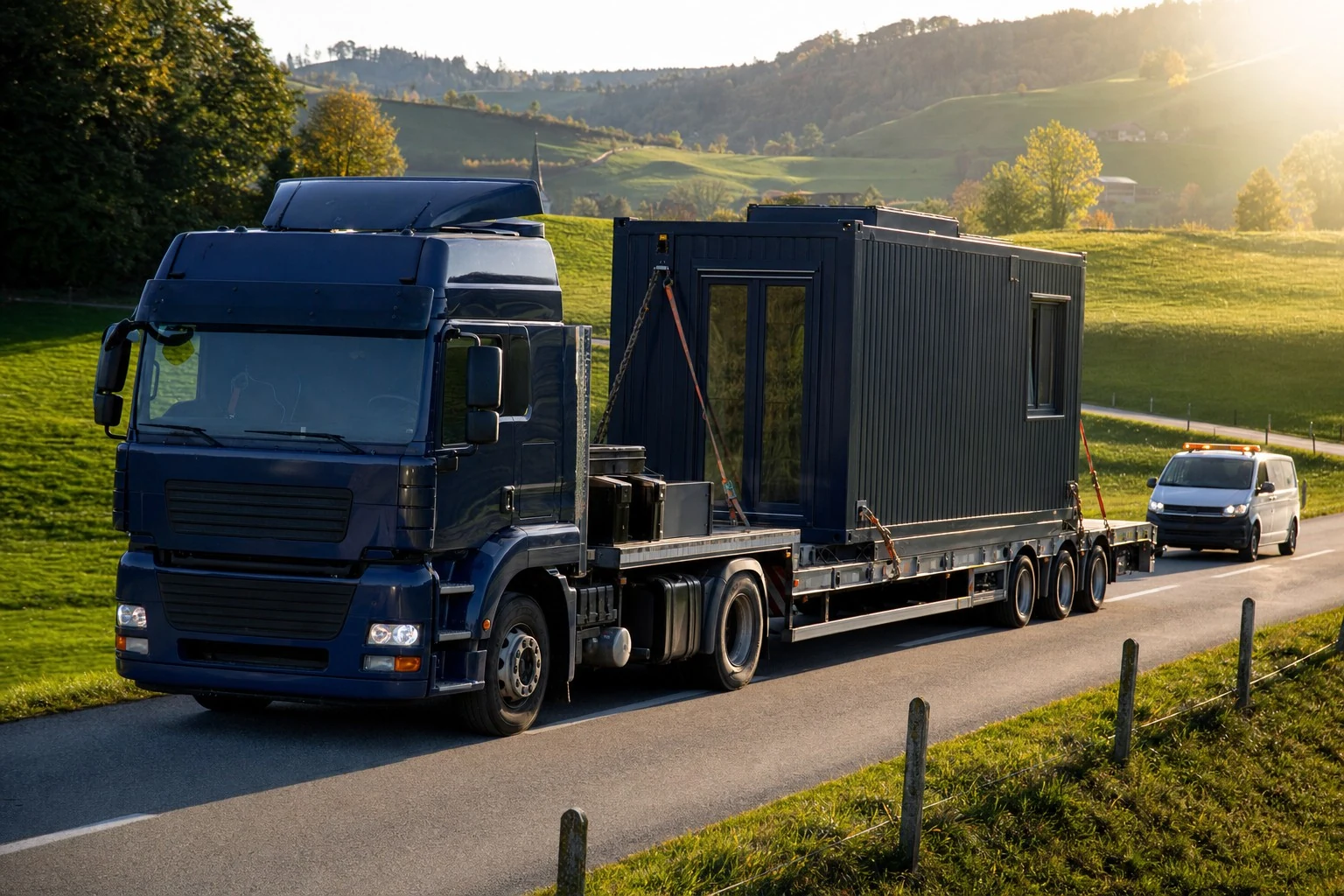
Rent or buy: on hardly any question do opinions on site diverge so quickly. One client swears by renting because it stays flexible. The next demonstrates that buying is cheaper in the long run. Both are right. Just not in the same project.
We rent out and sell modular buildings. So we have no interest in pushing you in one direction or the other. What we do have: experience of when which model works and when it gets expensive.
This article is a decision aid, not a sales pitch. At the end you will find the five questions you should ask yourself before deciding.
When renting wins
Renting plays to its strengths when the period of use is short or unclear. A temporary school building during a refurbishment. Site accommodation with a fixed end date. An office you do not know today whether you will still need in three years. Wherever an end is foreseeable or the future is open, renting buys you flexibility.
The financing side often speaks for renting too. The rental instalment runs through the budget as operating expenditure. You tie up no capital and need no investment decision. For municipalities and institutions in particular that is a tangible difference: in our experience, a temporary building funded from the operating budget is approved faster than an investment credit.
Then there is availability. A rented building normally stands sooner because it does not have to be produced first. If the space is needed in three months, that is often the decisive argument.
And at the end you simply hand the building back. No removal at your own expense, no residual value to look after, no building standing unused on the site. The return is part of the model.
When buying wins
As soon as the temporary building turns into permanent use, the calculation turns as well. The kindergarten that stays. The office building at the works depot that is meant to stand for twenty years. Anyone who rents a building over many years eventually pays more than it would have cost to buy. That is no criticism of the rental model, it is simply its logic: flexibility has a price.
The second reason is freedom. A building you have bought belongs to you. You can convert it, extend it, add a storey or use it differently without having to ask anyone. Anyone who knows their operation is growing usually wants that freedom.
And you keep the residual value: modular buildings can be relocated, repurposed or sold on. What you have bought is not gone at the end of its first use.
The grey area: rent-to-own and later purchase
Between renting and buying there is a third option: you rent first and take the building over later. That can make sense when the period of use is unclear at the outset and it only emerges over time that the building is staying.
We put that cautiously on purpose: whether a takeover is possible, and on what terms, depends on the project and on the building. It is an option, not an automatic right. If this scenario is conceivable for you, raise it early. Then it can be allowed for from the start, instead of being improvised at the end.
The rule of thumb, and why it is only a rule of thumb
The simple logic goes like this: renting costs little at the start, but keeps running as long as the building stands. Buying costs a lot at the start, after which only operation and maintenance remain. Somewhere these two lines cross. Before that point renting wins, after it buying does.
Exactly where the point lies depends on size, fit-out standard and terms. As a rough order of magnitude: with one to two years of use renting almost always wins, with ten years buying almost always does. In between lies the zone where you have to do the sums precisely. That is why we do not quote blanket figures but work it through project by project, honestly costed, not talked up.
The hidden items that clients forget
Most comparisons do not fail on the rental instalment or the purchase price. They fail on the items around them. Six of these turn up in almost every project:
- Transport and installation: arise in both models, and with renting twice, there and back. Clarify what is included in the rental instalment and what is charged separately.
- Foundations and site services: every building needs them, rented or bought. Foundations and connections for water, drainage and electricity are for your account in both models.
- Fit-out: with a purchase, the fit-out is an investment that stays in the building. With a rental, larger alterations only pay off if the term carries them.
- Servicing and maintenance: with a purchase you bear the maintenance over the whole standing time. With a rental, the contract governs which servicing is the lessor’s business and which is yours. Read that part carefully.
- Insurance: ownership and risk sit differently under renting and buying. Before signing the contract, clarify who insures the building and against what.
- Removal and return: with a rental, dismantling and return transport belong in the calculation. With a purchase you bear the removal yourself, but the residual value is yours.
Our advice: never compare the rental instalment with the purchase price. Set total costs against total costs, over the realistic period of use.
Five questions before you decide
Before you compare quotations, answer these five questions. Best in writing and as a team.
- How long do I really need the building, and how sure am I of that?
- Is there a realistic scenario in which the temporary building turns into permanent use?
- Do I want to invest or would I rather budget operating costs, and what does my budget process allow?
- Will I want to convert or extend the building later?
- What happens at the end: return, removal, repurposing or resale?
Anyone who answers these five questions clearly has usually already made half the decision.
Our honest verdict
There is no blanket answer, but there is a clean calculation. Renting wins with a short or uncertain period of use, buying with permanent use. In between it is the sums that decide, not gut feeling.
If you are facing this decision, bring your answers to the five questions with you. We put both options side by side, with all the items, including the awkward ones. And if renting comes out better than buying, we will tell you so. The other way round just the same.