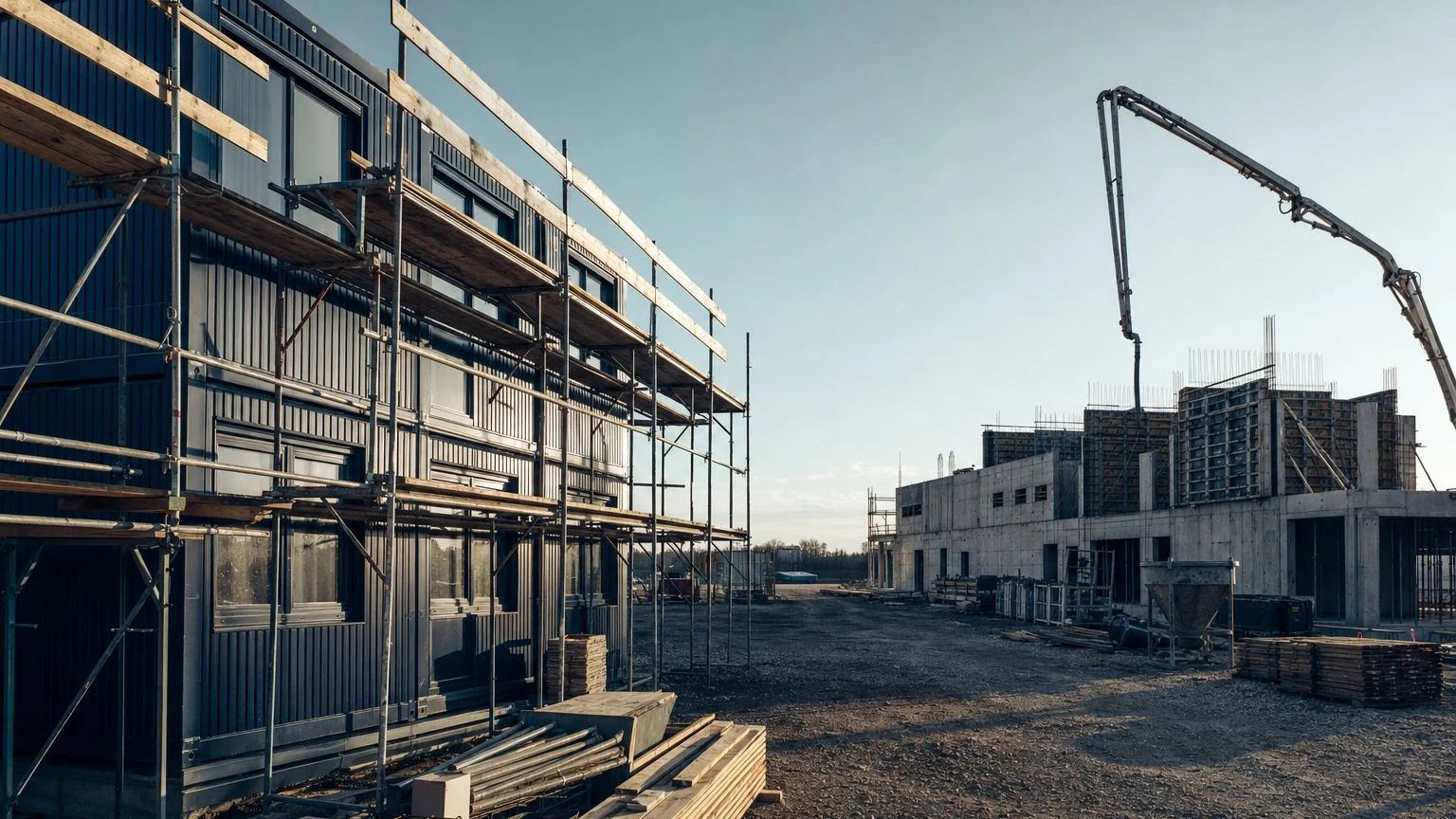
Anyone planning a building sooner or later hears both recommendations: build traditionally, because it lasts. Or build modular, because it is quick. Both are true. And neither is true all of the time.
We build modular buildings, that is our trade. Even so, what you read here is not advertising but the criteria we would use to decide ourselves: build time, costs, flexibility, quality. And at the end the question that tends to be missing from comparisons like this: when is traditional construction simply the better choice?
The comparison is aimed at municipalities, companies and private clients. That is, at everyone who is not looking for a method of construction but for the right building for their task.
Build time: the biggest difference
In traditional construction everything happens one after the other on the site: excavation, foundations, shell, roof, fit-out. Every step waits for the one before. Rain, frost and delivery times lengthen the chain.
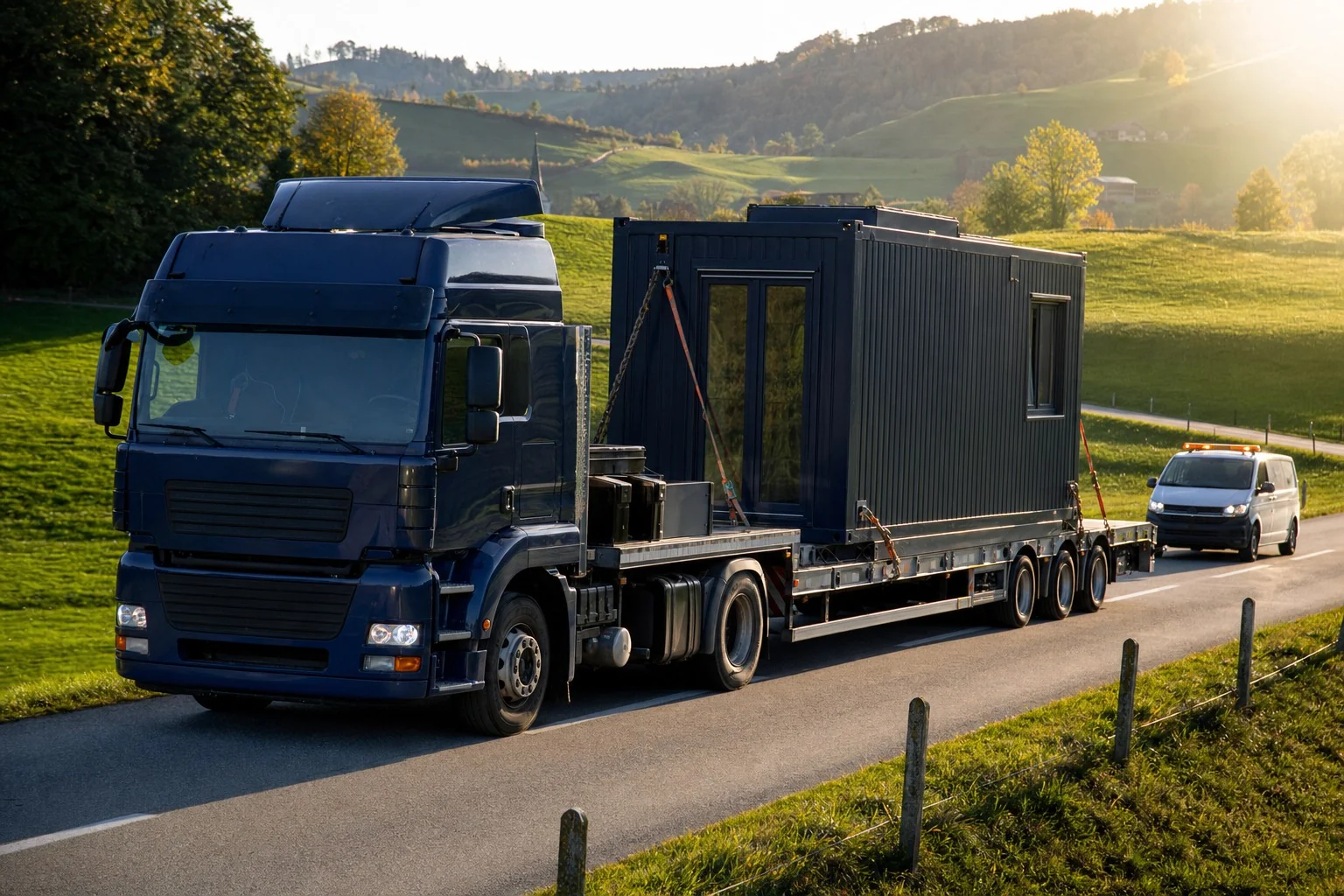
In modular construction two sites run in parallel. While the foundations go in on the plot, the modules are made in the factory: protected from the weather, electrical, plumbing and fit-out included. What remains on site at the end is installation and connections. That shortens the build time considerably, often from many months to a few.
For a municipality whose classroom space has to be ready in August, or a company that wants to grow without interrupting operations, that is often the decisive argument. How long it takes in a specific case depends on size, fit-out and permit. So we do not quote blanket figures, but a realistic programme after the first conversation.
Costs: where modular construction saves and where traditional construction catches up
What speaks for modular construction
Serial production in the factory is more efficient than one-off production on the construction site. Standardised packages for kitchen, electrical, plumbing or air conditioning make the costs plannable early on. And the short build time saves indirectly: less bridging finance, less loss of operation, earlier use.
On top of that comes an option that exists in this form only in modular construction: renting for a period. Anyone who needs a building for only a few years, as a temporary school building or site accommodation for example, ties up no capital in a structure they will not use afterwards.
What speaks for traditional construction
Over very long periods the advantage evens out. A solid traditional building stands for decades, and anyone who knows for certain that nothing will change about use, size and location does the sums differently over the service life. The higher initial outlay is then spread over many years, and the advantages of the short build time weigh less.
As a rule of thumb: the shorter and more clearly defined the use, the more plainly the calculation speaks for modular construction. The longer and more static the use, the closer the two methods move together. What applies to your project we work through with you, honestly costed, not talked up.
Flexibility: the underrated criterion
A traditional building stands where it stands. Conversions are possible, but expensive and drawn out. A modular building, by contrast, stays changeable for the whole of a building’s life:
- Extend: if the requirement grows, modules are added, at the side or as an additional storey.
- Relocate: if the location changes, the building moves, from one school site to the next for example.
- Reduce: if the requirement falls, the building is made smaller instead of standing half empty.
- Resell: a well-kept modular building has a residual value and finds a market.
For municipalities in particular this is relevant. Pupil numbers fluctuate, forecasts miss the mark, temporary buildings last longer than planned. In this situation a building that goes along with you is the smaller risk than one that stays for ever as it was built. The fact that modular buildings can be serviced, converted and maintained, regardless of manufacturer, keeps the value stable on top of that.
Quality: the container cliché and where things stand today
The most common prejudice first: modular construction is said to be “containers”, so noisy, cold in winter and hot in summer. That picture comes from a time when simple site containers had to serve as a permanent solution. It has little to do with a modular building today.
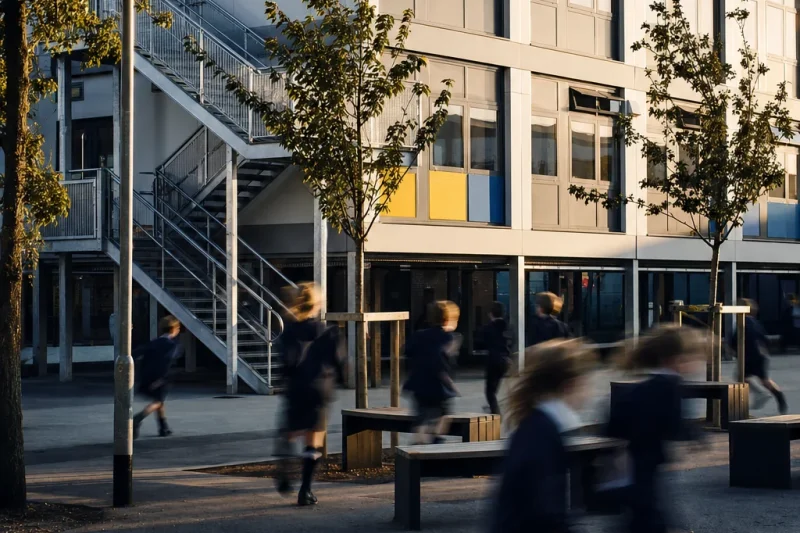
Modern buildings for office, school or kindergarten are insulated, heated, ventilated and designed for permanent use. Structure and fire protection are regulated as in any other building: anyone who wants a building permit meets the same requirements, regardless of the method of construction. A permitted modular building is not a second-class building.
One difference remains: modular construction works to a grid. Anyone seeking maximum architectural freedom runs into limits here. Anyone seeking bright, functional, solid rooms does not.
When traditional construction is the better choice
There are schemes for which we advise against modular construction:
- Architecture is the core of the project. Curved facades, large clear spans, a prestige one-off building that is deliberately meant to have no grid: that is the world of traditional construction.
- Many storeys, high loads. Modular construction works over several storeys, but not without limit. Anyone building markedly upwards, or accommodating heavy special uses such as machinery or storage with high floor loads, is better served by traditional construction.
- A location for generations, with no time pressure. If it is settled that the building will stay unchanged in the same place for decades, and build time plays no part, modular construction loses its two strongest arguments.
Often the answer is not either/or. Basements, underground car parks and elements in contact with the ground are built traditionally in any case. Above them, modular construction is possible. We examine such combinations case by case.
Our honest verdict
Modular construction wins on build time, predictability and flexibility. Traditional construction wins on free architecture, great heights and very long, unchanged uses. Anyone who describes their own task soberly, how long, how big, how fixed, usually has the answer sooner than expected.
And if you are unsure: ask us. We plan, build and look after modular buildings for temporary and permanent use, for rent and for purchase. In conversation we will also tell you when modular construction is not the right solution for your scheme.